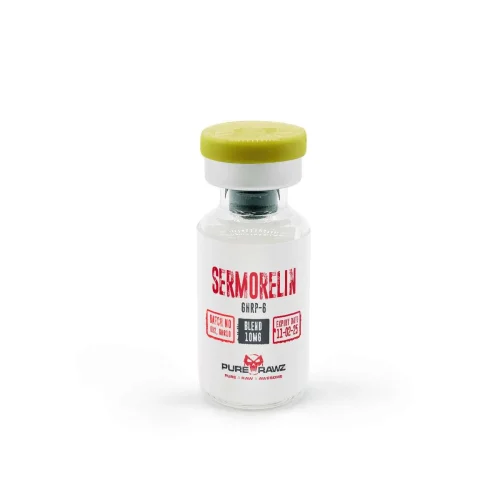
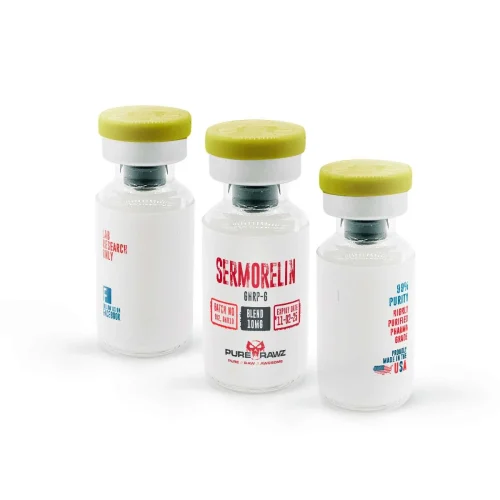
Sermorelin + GHRP-6 Blend
$97.81
Earn 98 points upon purchasing this product.
✅ 99% Purity – Third-Party Tested
🚚 Free U.S. Shipping on Orders $100+
🇺🇸 Proudly Made in the USA
⚡ Fast & Reliable Shipping
🔒 Secure Checkout Guaranteed
Enjoy 24/7 customer support, 1st & 3rd party verified 99% purity, and free shipping on orders over $100!
Sermorelin for Sale — Lab-Certified GHRH(1-29) Research Peptide
Researchers seeking sermorelin for sale with rigorously documented purity credentials will find PureRawz sets the benchmark for research-grade quality in the GHRH analogue supply market. Our Sermorelin acetate — the synthetic 29-amino acid N-terminal fragment of growth hormone-releasing hormone (GHRH 1–29) — is manufactured under controlled laboratory conditions, verified by accredited independent third-party testing, and shipped directly from our USA-based facility. Every vial is supported by a dual Certificate of Analysis covering both HPLC-confirmed purity and endotoxin load, each document uniquely traceable to the lot number on your vial. This is research-grade Sermorelin built for rigorous science — available for direct purchase without consultation gates or prescription requirements.
Sermorelin Acetate Product Specifications
- Full Name: Sermorelin Acetate / Growth Hormone-Releasing Hormone (1–29) / GRF(1–29)
- Also Known As: GHRH(1–29), Geref (discontinued brand), Somatocrinin fragment
- Amino Acid Sequence (29 AA): Tyr-Ala-Asp-Ala-Ile-Phe-Thr-Asn-Ser-Tyr-Arg-Lys-Val-Leu-Gly-Gln-Leu-Ser-Ala-Arg-Lys-Leu-Leu-Gln-Asp-Ile-Met-Ser-Arg-NH₂
- Molecular Formula: C₁₄₉H₂₄₆N₄₄O₄₂S
- Molecular Weight: 3,357.93 g/mol
- CAS Number: 86168-78-7
- PubChem CID: 16129620
- C-Terminal Modification: Amidated (–NH₂) — essential for GHRH receptor binding affinity
- Biological Target: GHRH receptor (GHRHR) — Class B G protein-coupled receptor on anterior pituitary somatotrophs
- Half-Life (preclinical models): 10–20 minutes (rapid enzymatic degradation in plasma)
- Purity: ≥99% (HPLC verified)
- Verification Methods: HPLC + Mass Spectrometry
- Endotoxin Testing: LAL assay — COA issued per batch
- Form: Lyophilized powder (acetate salt)
- Available Sizes: 2mg, 5mg, 10mg per vial
- Storage: −20°C (long-term); 2–8°C (short-term, up to 4 weeks); protect from light
- Lot Number: Unique per batch — cross-referenced to COA
- Shipping Origin: USA — 1 business day processing
Dual COA Certification — PureRawz Quality Documentation Standard
Every batch of Sermorelin acetate from PureRawz is released only after passing independent third-party laboratory verification. We issue two separate Certificates of Analysis per production lot — a documentation standard that exceeds what most research peptide suppliers provide:
- Purity COA — HPLC and mass spectrometry analysis confirming ≥99% peptide purity. Verifies the 29-amino acid sequence integrity, C-terminal amidation, and acetate salt form. Unique lot-number specific — tied to the exact production batch in your vial.
- Endotoxin COA — LAL (Limulus Amebocyte Lysate) assay documenting endotoxin (LPS) concentration per batch. Essential documentation for any in-vivo preclinical research involving hypothalamic-pituitary signaling models where LPS contamination would produce confounding neuroendocrine and inflammatory effects that directly interfere with GH secretion readouts.
Each COA is permanently matched to the unique lot number printed on your vial. PureRawz does not issue shared, recycled, or undated certificates across production runs. Researchers receive batch-specific documentation they can attach to institutional procurement records and experimental chain-of-custody files.
What Is Sermorelin? GHRH(1-29) Research Background and Mechanism
Sermorelin acetate is a synthetic peptide analogue comprising the first 29 amino acids of endogenous human growth hormone-releasing hormone (GHRH 1–44). It represents the shortest fully biologically active N-terminal fragment of GHRH capable of retaining complete receptor binding affinity and downstream signaling activity. First developed as a diagnostic pharmaceutical (brand name Geref, manufactured by Serono), Sermorelin received FDA approval in 1997 for the evaluation of pituitary GH reserve in children. Commercial production was discontinued in 2008, though Sermorelin remains one of the most extensively studied GHRH analogues in the published preclinical literature.
Molecular Mechanism: GHRH Receptor Signaling Cascade
Sermorelin's biological activity in research models operates through a well-characterized receptor-mediated signaling cascade:
- Receptor binding: Sermorelin binds the GHRH receptor (GHRHR), a Class B G protein-coupled receptor (GPCR) expressed on anterior pituitary somatotroph cells. The C-terminal amidation of the Ser-Arg sequence at position 29 is structurally essential for high-affinity receptor engagement — a modification confirmed by mass spectrometry in PureRawz COA documentation
- Gs-protein activation: GHRHR coupling to Gs protein activates adenylate cyclase, driving intracellular cyclic AMP (cAMP) accumulation within somatotroph cells
- PKA-dependent signaling: Elevated cAMP activates protein kinase A (PKA), which phosphorylates transcription factors including CREB (cAMP response element-binding protein), stimulating GH gene transcription and GH vesicle exocytosis
- Somatostatin feedback: GH release from sermorelin stimulation remains subject to inhibitory somatostatin feedback — a physiological regulatory mechanism that prevents supraphysiological GH surges in preclinical models, distinguishing sermorelin from direct exogenous GH administration in research designs
- IGF-1 downstream effects: In in-vivo animal models, GH released following sermorelin administration drives hepatic IGF-1 synthesis — a measurable downstream biomarker used in preclinical GH axis research protocols
Somatopause Research Applications
Age-associated decline in endogenous GH secretion — termed somatopause in the research literature — is a well-documented phenomenon in mammalian aging biology. GHRH pulse frequency and amplitude decline significantly with age, reducing somatotroph stimulation and downstream IGF-1 production. Sermorelin is widely used as a research tool in somatopause models to investigate whether upstream GHRH receptor stimulation can restore aspects of pulsatile GH secretion patterns. Published preclinical and translational studies by Walker et al. (Clinical Interventions in Aging, 2006) and Thorner et al. (JCEM, 1986) form the primary reference literature for sermorelin's research applications in this context.
Sermorelin vs HGH vs CJC-1295 — Research Compound Comparison
Researchers investigating the somatotropic axis frequently need to select between GHRH analogues and direct GH preparations. The following comparison outlines the key mechanistic and experimental distinctions relevant to laboratory research design:
| Parameter | Sermorelin (GHRH 1–29) | Recombinant HGH | CJC-1295 (GHRH analogue) |
|---|---|---|---|
| Mechanism | GHRHR agonist — stimulates endogenous GH | Direct GH replacement — bypasses axis | GHRHR agonist — enhanced stability vs Sermorelin |
| Half-Life | 10–20 minutes | ~3–5 hours | ~6–8 days (DAC form) |
| Somatostatin Feedback | Preserved — physiological GH pulsatility | Bypassed — flat GH exposure | Partially preserved — blunted pulsatility |
| Tachyphylaxis Risk | Low — feedback intact | High — receptor desensitization documented | Moderate — extended exposure profiles |
| Amino Acid Length | 29 amino acids | 191 amino acids | 29 amino acids (modified) |
| Molecular Weight | 3,357.93 g/mol | ~22,125 Da | ~3,647 g/mol |
| FDA History | Approved 1997, discontinued 2008 | Approved (restricted schedule) | Never FDA approved — research only |
| Research COA Standard (PureRawz) | Dual: Purity + Endotoxin COA | N/A — not sold as research peptide | Dual: Purity + Endotoxin COA |
How to Reconstitute Sermorelin — Laboratory Reference Protocol
Sermorelin acetate is a sensitive peptide with a short half-life in aqueous solution. Correct reconstitution and handling technique is essential for maintaining peptide integrity, C-terminal amidation stability, and reproducible experimental outcomes across in-vivo and in-vitro protocols.
Materials Required for Sermorelin Reconstitution
- Sermorelin acetate lyophilized vial (≥99% purity, lot number verified against COA)
- Bacteriostatic water (0.9% benzyl alcohol) — preferred for multi-use research vials
- Sterile water for injection — for single-use preparations
- 1mL insulin syringe with 27–29 gauge needle (fine gauge reduces peptide shear stress)
- 70% isopropyl alcohol swabs
- Cold storage (2–8°C) ready immediately post-reconstitution
- Light-protective storage (amber vial or foil wrap — Sermorelin is moderately light sensitive)
Step-by-Step Sermorelin Reconstitution Procedure
- Verify lot number and vial integrity: Cross-reference the lot number on the vial label against your Purity COA and Endotoxin COA before proceeding. Sermorelin lyophilized powder appears white to off-white. Discard any vial with visible moisture, discolouration, or damaged septum.
- Equilibrate to room temperature: Allow the sealed vial to reach room temperature (approximately 15–20 minutes from −20°C storage) before introducing any solvent. Temperature equilibration prevents condensation on the powder and ensures even dissolution.
- Swab the septum: Clean the rubber stopper with a 70% isopropyl alcohol swab. Allow 10–15 seconds to air-dry completely.
- Calculate your working concentration:
- 2mg vial + 1mL bacteriostatic water = 2mg/mL (2,000 mcg/mL)
- 2mg vial + 2mL bacteriostatic water = 1mg/mL (1,000 mcg/mL)
- 5mg vial + 2.5mL bacteriostatic water = 2mg/mL (2,000 mcg/mL)
- 10mg vial + 5mL bacteriostatic water = 2mg/mL (2,000 mcg/mL)
- Inject solvent slowly against the glass wall: Angle the needle and direct bacteriostatic water in a slow, steady stream against the inner glass — never directly onto the lyophilized powder. High-velocity direct injection can disrupt the C-terminal amide bond and degrade the peptide structure. Allow gentle passive dispersion.
- Allow passive dissolution: Do not shake, vortex, or agitate. Allow 3–5 minutes for Sermorelin to dissolve passively. Gently swirl if required. The solution should appear clear and colourless. Sermorelin dissolves readily in aqueous bacteriostatic water without the need for co-solvents.
- Inspect and label: Discard any solution that appears cloudy, particulate, or yellow-tinged — these are signs of degradation or contamination. Label the vial with the reconstitution date and lot number.
- Store immediately at 2–8°C: Sermorelin in solution has a markedly shorter stability window than most lyophilized research peptides due to its short half-life and susceptibility to plasma and tissue peptidase degradation.
- Bacteriostatic water solutions: stable for up to 21 days refrigerated
- Sterile water solutions: use within 24 hours
- Do not freeze reconstituted Sermorelin solution — freeze-thaw cycling degrades amide bond stability
Research handling note: Sermorelin's extremely short plasma half-life (10–20 minutes) means timing of administration in in-vivo protocols is critical. Prepare fresh aliquots close to administration time for highest experimental consistency. For gene expression and IGF-1 endpoint studies, account for rapid peptide clearance when designing sample collection windows.
Sermorelin Research Protocols in Preclinical Studies
Disclaimer: The following information is drawn exclusively from published peer-reviewed preclinical research literature and is provided for scientific reference purposes only. PureRawz does not provide medical advice, prescribe medications, or recommend dosing for human use. All information below is intended for qualified researchers designing laboratory research protocols. Sermorelin is not approved by the FDA for human use in any current indication.
Published Preclinical Research Parameters
- In-vitro pituitary cell assays: 0.1 nM – 10 nM range most commonly used in somatotroph cell stimulation models; GH secretion and cAMP accumulation are primary measured endpoints at these concentrations
- In-vivo rodent models (GH axis stimulation): 1–10 mcg/kg subcutaneous administration reported in published murine somatrophin studies; most commonly administered immediately pre-dark phase to align with nocturnal GH pulsatility in rodent models
- Dose-response studies (rat models): Dose-dependent GH secretion documented from approximately 0.3 mcg/kg to 30 mcg/kg in intravenous administration models; subcutaneous administration shows attenuated but sustained GH release profiles compared to IV
- IGF-1 endpoint studies: Walker et al. (2001) reported progressive serum IGF-1 elevation over 12 weeks of repeated GHRH stimulation in non-human models — a commonly referenced timeframe for GH axis conditioning protocols in published literature
- Administration routes studied: Subcutaneous (SC) most common in in-vivo literature; intravenous (IV) used in acute GH secretion kinetics studies; intranasal delivery studied in select models as an alternative to injection-based protocols
- Timing considerations: Published protocols consistently note maximal GH secretion response when GHRH analogues are administered during the early quiescent phase of the ultradian GH rhythm — typically aligned with slow-wave sleep phases in nocturnal study designs
Key Research Variables and Experimental Design Considerations
- Somatostatin tone: Background somatostatin levels in the experimental model significantly influence the GH secretion response to sermorelin — a critical confounding variable in in-vivo hypothalamic-pituitary axis models. Fasting state, stress, and hyperglycemia all modulate somatostatin and should be controlled in study design
- Tachyphylaxis monitoring: Unlike direct GH administration, sermorelin preserves negative feedback integrity — but extended high-dose protocols in animal models should still monitor for GHRHR desensitization through receptor internalization assays
- C-terminal amidation verification: Always confirm C-terminal amidation (–NH₂) via mass spectrometry in your COA before initiating receptor binding or GH secretion assays — non-amidated GHRH fragments show dramatically reduced GHRHR affinity and will produce confounded results
- Endotoxin control: LPS contamination at sub-threshold levels directly suppresses pituitary GH secretion through IL-1β and IL-6 signalling — making endotoxin COA documentation not merely a quality checkbox but an experimental necessity for any in-vivo GH axis research model
Related GHRH Axis Research Peptides — Frequently Studied with Sermorelin
Researchers investigating sermorelin's role in the somatotropic axis frequently co-administer or compare the following compounds in published multi-peptide research protocols. All PureRawz peptides are independently third-party tested, lot-verified, ≥99% pure, and ship from our USA facility:
- CJC-1295 (GHRH Analogue — Extended Half-Life) — A modified GHRH(1–29) analogue with amino acid substitutions that dramatically extend plasma half-life to approximately 6–8 days (DAC form). Compared directly with Sermorelin in receptor selectivity, GH pulsatility, and IGF-1 elevation studies. Third-party tested ≥99% purity, dual COA, USA shipping. The most commonly studied long-acting alternative to Sermorelin in GHRH axis research.
- Ipamorelin (GHS-R1a Agonist / GH Secretagogue) — A selective pentapeptide ghrelin receptor agonist that stimulates GH release through an entirely separate receptor pathway (GHS-R1a via Gq/11 calcium signaling) than sermorelin (GHRHR via Gs/cAMP). Frequently co-administered with sermorelin in published research to investigate synergistic GH axis activation through dual-receptor protocols. Lab-verified ≥99% purity, lot-traceable, fast USA shipping.
- GHRP-6 (Growth Hormone-Releasing Peptide 6) — A synthetic hexapeptide GHS-R1a agonist studied in comparative receptor pharmacology alongside Sermorelin. Investigated for GH pulse amplitude, ghrelin axis interactions, and appetite-related signaling in preclinical models. Combined Sermorelin + GHRP-6 blend available separately. Third-party tested, ≥99% purity, USA shipping.
-
Sermorelin + GHRP-6 Blend
Sermorelin + GHRP-6 Blend is a popular peptide combination commonly explored for growth hormone support, recovery studies, performance enhancement, and advanced laboratory applications.
Browse related Purerawz peptides and trusted scientific references below.Related Products
- Buy Sermorelin Online – growth hormone peptide research
- Sermorelin for Sale – advanced peptide support studies
- Buy MK-677 – growth hormone support research
- Buy IGF-1 LR3 – muscle growth and recovery studies
- Buy AOD 9604 – metabolism and peptide research
- Buy MOTS-c – mitochondrial and metabolic support studies
Research References
-
PubMed Research Database
– scientific studies and published research -
National Center for Biotechnology Information (NCBI)
– biomedical and research resources -
U.S. Food and Drug Administration
– regulatory and compliance reference
Additional information
| Attributes | Sermorelin + GHRP-6 = 10mg Total |
|---|
Reviews
There are no reviews yet.