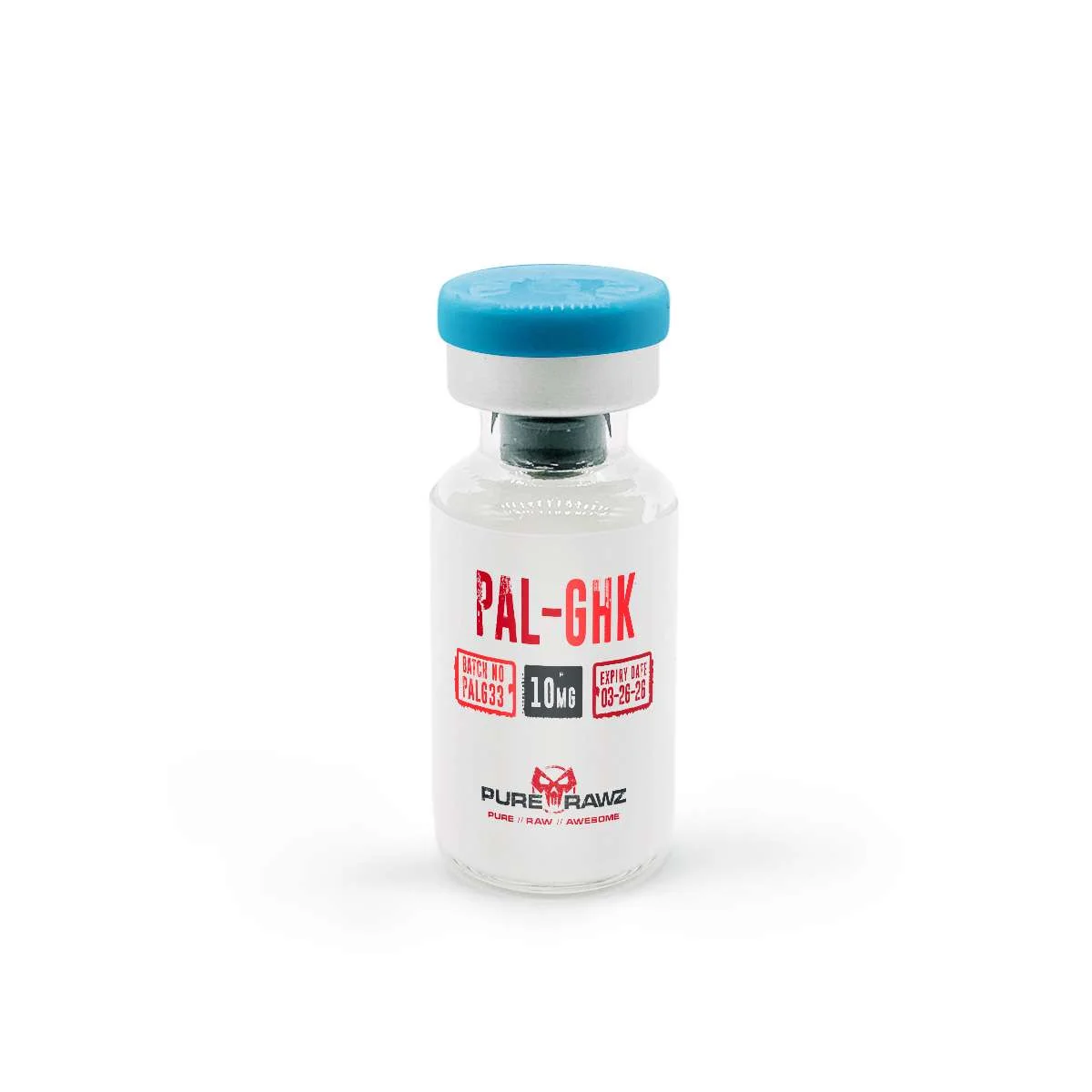
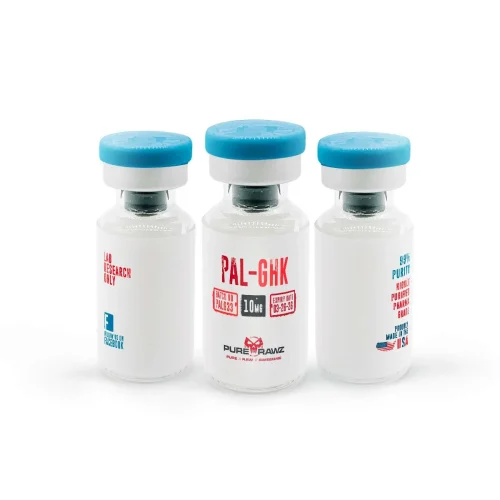
PAL-GHK
$43.16
Earn 43 points upon purchasing this product.
✅ 99% Purity – Third-Party Tested
🚚 Free U.S. Shipping on Orders $100+
🇺🇸 Proudly Made in the USA
⚡ Fast & Reliable Shipping
🔒 Secure Checkout Guaranteed
Enjoy 24/7 customer support, 1st & 3rd party verified 99% purity, and free shipping on orders over $100!
Buy GHK-Cu — Lab-Verified Copper Peptide for Preclinical Research
Researchers who need to buy GHK-Cu with fully documented, independently verified purity credentials will find PureRawz delivers the rigorous research-grade standard the scientific community demands. Our GHK-Cu (Glycyl-L-Histidyl-L-Lysine-Copper) is a synthetic, lyophilized copper tripeptide complex manufactured under strict laboratory controls, tested by accredited independent third-party laboratories, and shipped directly from our USA-based facility. Every vial is accompanied by a dual Certificate of Analysis — purity and endotoxin — both traceable to the unique lot number on your vial. This is not a cosmetic formulation or a wellness supplement. This is research-grade GHK-Cu built for the laboratory.
GHK-Cu (Copper Peptide) Product Specifications
- Full Chemical Name: Glycyl-L-Histidyl-L-Lysine-Copper(II) complex
- Common Names: GHK-Cu | Copper Tripeptide-1 | Cu-GHK | Copper Peptide
- Peptide Sequence: Gly-His-Lys (Cu²⁺ chelated)
- Molecular Formula: C₁₄H₂₃CuN₆O₄
- Molecular Weight: 401.91 g/mol (copper complex); 340.38 g/mol (free tripeptide)
- CAS Number: 89030-95-5 (copper complex) / 49557-75-7 (free peptide)
- PubChem CID: 73587
- Physical Form: Blue to blue-green lyophilized powder
- Purity: ≥99% (HPLC verified)
- Verification Methods: HPLC + Mass Spectrometry
- Endotoxin Testing: LAL assay — COA issued per batch
- Copper Coordination: Cu²⁺ chelated via imidazole nitrogen (His), α-amino group (Gly), and deprotonated amide nitrogen (Gly-His bond)
- Available Size: 50mg and 100mg per vial
- Storage: −20°C (long-term); 2–8°C (short-term up to 4 weeks); protect from light
- Lot Number: Unique per batch — matched to COA documentation
- Shipping Origin: USA — 1 business day processing
Dual COA Certification — The PureRawz Documentation Standard
Every batch of GHK-Cu supplied by PureRawz is independently verified by an accredited third-party laboratory before release. We issue two separate Certificates of Analysis per production lot:
- Purity COA — HPLC and mass spectrometry analysis confirming ≥99% peptide-copper complex purity. Confirms molecular identity of the Gly-His-Lys tripeptide sequence and copper coordination integrity. Lot-number specific — tied to the exact batch you receive.
- Endotoxin COA — LAL (Limulus Amebocyte Lysate) assay confirming endotoxin load per batch within research-acceptable parameters. Critical for any in-vivo preclinical research where LPS contamination could confound inflammatory signalling, fibroblast activity, or wound model outcomes.
Each COA is permanently cross-referenced to the unique lot number on your vial. Unlike suppliers who issue generic, undated, or shared lab reports across product lines, PureRawz generates a fresh, lot-specific COA for every production run. Researchers receive full documentation traceability — the standard that rigorous laboratory procurement requires.
What Is GHK-Cu? Research Background and Molecular Mechanism
GHK-Cu (Glycyl-L-Histidyl-L-Lysine-Copper) is a naturally occurring low-molecular-weight copper-binding tripeptide first isolated from human blood plasma albumin by researcher Loren Pickart in 1973. It has since been identified in saliva and urine, and is present in highest concentrations in platelets, wound fluid, and plasma — particularly in younger individuals. Human plasma levels of GHK are reported at approximately 200 ng/mL at age 20, declining to approximately 80 ng/mL by age 60, a trajectory that has driven substantial research interest in its role in tissue homeostasis and cellular signaling.
Molecular Mechanism: Copper Coordination and Cellular Signaling
The biological activity of GHK-Cu is fundamentally tied to its copper chelation structure. The Cu²⁺ ion is coordinated by three specific sites within the tripeptide:
- The nitrogen of the imidazole side chain of L-Histidine
- The α-amino group of Glycine (N-terminal)
- The deprotonated amide nitrogen of the Gly-His peptide bond
This coordination architecture gives GHK-Cu an exceptionally high copper-binding stability constant (log K₁ = 16.44), making it one of the most effective endogenous copper transport and delivery systems studied in laboratory contexts. By sequestering copper in a redox-controlled form, the GHK-Cu complex limits metal-catalyzed oxidative stress while delivering bioavailable Cu²⁺ to copper-dependent enzymes including lysyl oxidase (essential for collagen cross-linking) and superoxide dismutase (SOD1).
Gene Expression Research — The 4,000-Gene Modulation Finding
Among the most studied preclinical findings associated with GHK-Cu is its documented influence on large-scale gene expression. Transcriptomic analyses in published research have identified GHK-Cu modulating the activity of more than 4,000 human genes — approximately 31% of the gene segments studied — with observations including upregulation of tissue repair pathways, antioxidant defense enzymes, and extracellular matrix remodeling markers, alongside downregulation of inflammatory and oxidative stress indicators. These findings position GHK-Cu as a broad-spectrum molecular research tool for genomics, proteomics, and pathway biology studies rather than a single-target compound.
GHK-Cu vs GHK — Critical Research Distinction
A frequently encountered source of experimental error in GHK research is the conflation of GHK (the free tripeptide) with GHK-Cu (the copper-chelated complex). These are chemically and biologically distinct entities, and their differences are critical for experimental design:
GHK — Free Tripeptide (No Copper)
- Molecular Weight: 340.38 g/mol
- CAS Number: 49557-75-7
- Form: White to off-white powder
- Activity: Markedly reduced biological activity compared to the copper complex — GHK alone lacks the copper-delivery function that drives most documented downstream signaling effects in fibroblast, wound, and gene expression models
- Research Note: Some studies use GHK as a negative control or baseline comparator against GHK-Cu to isolate copper-dependent vs. peptide-only effects
GHK-Cu — Copper Complex (Research-Active Form)
- Molecular Weight: 401.91 g/mol
- CAS Number: 89030-95-5
- Form: Blue to blue-green powder (characteristic copper coloration)
- Activity: Full copper coordination intact — the biologically active research form studied across fibroblast proliferation, wound model, oxidative stress, and gene expression assays
- Verification: Always confirm copper coordination via mass spectrometry in your COA — HPLC alone cannot confirm metal chelation status
- PureRawz Standard: Our HPLC + mass spectrometry dual verification confirms both peptide sequence integrity and copper complex identity — not just peptide purity alone
Key purchasing alert for researchers: Suppliers offering GHK-Cu at unusually low prices may be supplying the cheaper free GHK tripeptide without confirmed copper coordination. Always verify the CAS number (89030-95-5 for the copper complex), the characteristic blue coloration of the lyophilized powder, and mass spectrometry identity confirmation in the COA before use.
Why Buy GHK-Cu from PureRawz — Research-Grade Source Comparison
The GHK-Cu market in 2026 includes a wide range of product types — from research-grade lyophilized powders to consumer cosmetics and wellness supplements. Not all are equivalent for laboratory use. The following comparison reflects key differentiators for research procurement decisions:
| Quality Factor | PureRawz | Typical Consumer Brand |
|---|
| Attributes | 10mg |
|---|
Reviews
There are no reviews yet.